
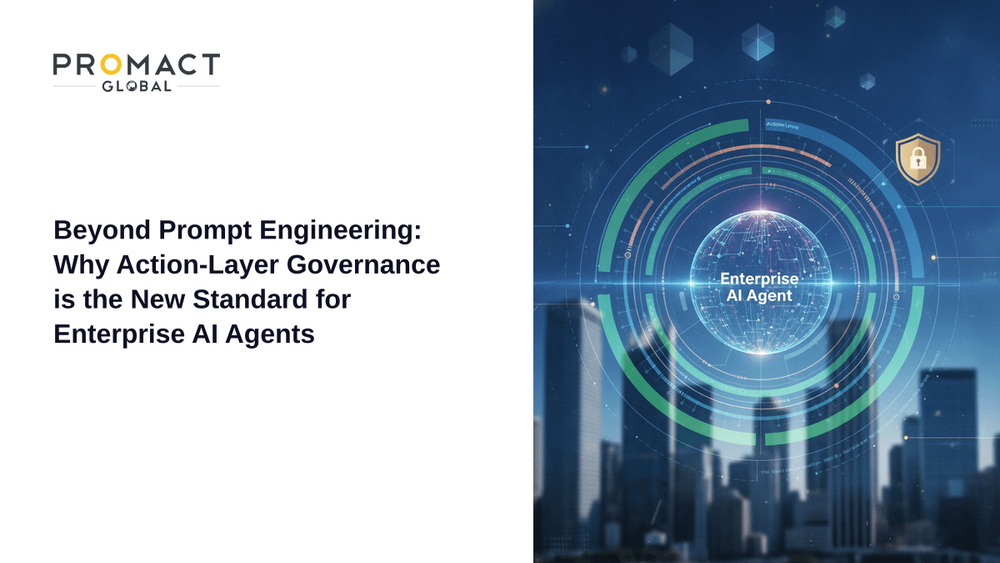
Beyond Prompt Engineering: Why Action-Layer Governance is the New Standard for Enterprise AI Agents
Key Points:
- The Paradigm Shift: Enterprise AI is rapidly evolving from conversational systems (generative AI) to autonomous systems (agentic AI), shifting the core risk from what an AI says to what an AI does.
- The looming crisis: Research suggests that without proper governance, up to 40% of enterprises may be forced to decommission their autonomous AI agents by 2027 due to unexpected production incidents.
- The solution: Securing AI now requires a two-layer architecture. While traditional prompt engineering and content guardrails remain essential for text generation, organizations must adopt strict “action-layer governance” to control API calls, database queries, and system transactions.
- Regulatory pressures: Emerging regulations like the EU AI Act are mandating per-decision reconstructable audit records for high-risk AI, making runtime execution oversight an urgent legal necessity.
Understanding the Transition For the past few years, the enterprise AI conversation has been dominated by prompt engineering and content filtering. We built chatbots and knowledge bases, and our primary concern was ensuring the AI didn’t hallucinate, leak sensitive data, or generate biased content. This was complex, but relatively safe, because human operators were always the final decision-makers. They read the AI’s output and decided whether to act on it.
The Introduction of Autonomous Agents Agentic AI changes this dynamic entirely. Instead of just generating text, AI agents plan, utilize tools, call APIs, and execute multi-step workflows autonomously. They can send emails, modify CRM records, trigger financial transactions, and alter production systems. This is akin to giving an AI a set of hands. While this unlocks incredible productivity, it also bypasses traditional security models. If an AI agent has the authority to act, a compromised model or a flawed decision can instantly become a compromised enterprise system.
The Need for Action-Layer Governance To bridge this gap, the security industry is moving toward “action-layer governance.” This approach separates the AI’s reasoning capabilities from its physical ability to execute tasks. It places a deterministic, verifiable firewall between the AI and the enterprise infrastructure. In this comprehensive guide, we will explore why traditional AI security is failing autonomous agents, the converging risks that create enterprise exposure, and how forward-thinking organizations are building the next generation of AI governance.
*
The Evolution of AI: From Thinking to Doing
The AI security market is currently saturated with vendors racing to protect prompts, harden models, detect jailbreaks, and scan for data leakage at the Large Language Model (LLM) layer. While this investment is well-intentioned, it primarily addresses the challenges of 2023, not the realities of today’s agentic AI landscape.
When early generative AI deployments were mostly conversational interfaces, the risk profile was confined to prompt injection and output misuse. However, as AI systems shift from analyzing to acting, the threat model changes fundamentally.
When an AI agent decides to execute a task—reaching out through tools or servers to interact with internal APIs, third-party services, or file storage—it leaves the model layer entirely and enters enterprise infrastructure. This is the action layer. Securing the “brain” (the LLM) without securing the “hands” (the execution pathways) is no longer a viable security strategy.
The Dual-Layer AI Security Stack
To achieve complete enterprise AI security, organizations must implement two distinct control surfaces:
- Content-Layer Security (Guardrails): This protects what AI systems communicate. It operates at the conversational boundary, filtering malicious prompts, sanitizing outputs, preventing data leakage in text, and halting prompt injections.
- Action-Layer Security (Constraints): This governs what AI systems execute. Sitting between the agent’s reasoning and the tool invocation, it intercepts every action before it executes to evaluate it against centralized policies.
A practical example of this division can be seen in modern tooling. Platforms like Guardrails AI validate what the model says (the output boundary), whereas action-governance platforms like Kite Logik govern what the agent does (the tool boundary, evaluating requests against policies before execution). If an agent calls real tools, action-layer governance must be the priority.
The “Lethal Trifecta” of Agentic AI Risk
Why exactly are AI agents so dangerous if left ungoverned? Databricks CISO Omar Khawaja has popularized a concept known as the “Lethal Trifecta” of agentic risk—three converging conditions that create massive, enterprise-scale exposure.
The risk profile of an AI system spikes exponentially when these three conditions are present simultaneously:
- Access to sensitive systems: The agent has permissions to retrieve private, restricted, or highly confidential data.
- Processing untrustworthy inputs: The agent ingests information from the open internet, external users, or unverified third-party sources.
- Autonomy and tool usage: The agent has the authority to make real-time decisions about which tools to invoke and which data paths to traverse to solve a problem.
When agents loop through sub-tasks autonomously, they engage in “Discovery and Traversal”. An agent designed to find a solution will traverse data paths and interfaces that were never intended for the requesting user. Without proper action-layer constraints, the user effectively inherits the agent’s elevated permissions rather than their own, bypassing traditional Identity and Access Management (IAM) controls.
Why Traditional AI Governance is Failing
Most AI governance programs were designed for model outputs, not autonomous actions. Oversight historically stopped at training validation or pilot controls. But as agents become central to enterprise workflows, this legacy approach is proving disastrous.
The 40% Decommission Prediction
Research firm Gartner recently issued a stark warning: by 2027, 40% of enterprises will be forced to demote or decommission autonomous AI agents due to governance gaps that are only discovered after production incidents occur.
According to Shiva Varma, Senior Director Analyst at Gartner, the root cause of these impending failures is that enterprises treat AI agent governance as a binary state: agents are either completely locked down or fully trusted.
Applying uniform governance to all AI agents, regardless of their autonomy level, triggers two failure modes:
- Over-restriction of simple agents: Applying heavy compliance to a basic read-only document summarizer slows delivery and drives shadow IT.
- Under-restriction of autonomous agents: Allowing write-access agents to execute actions without runtime proxies drastically increases security, operational, and compliance risks.
Risk scales with three distinct variables: how irreversible the action is, how sensitive the data is, and how many downstream systems the agent can impact. An agent that writes to internal logs requires vastly different governance than an agent that executes financial transfers or sends external client communications.
The Illusion of “Good Behavior”
According to MindStudio’s enterprise governance research, roughly 80% of organizations report risky behaviors from their AI agents, such as unexpected system interactions or unauthorized data access. Today, the only thing standing between a malicious prompt injection and a real-world enterprise transaction is often the LLM’s “good behavior”.
This is not a security control. The LLM can be jailbroken; a runtime authorization proxy cannot.
Building a Robust Action-Layer Governance Framework
To prevent the chaotic sprawl of ungoverned agents, organizations must evolve their governance from passive policy documents to sustained, infrastructure-level operational control. Effective action-layer governance requires several critical components.
1. Pre-Execution Validation and Runtime Proxies
Action-layer security should operate at the infrastructure level, not be embedded within individual agents. By placing a runtime proxy between agents and enterprise systems, every consequential action can be evaluated against centralized policies before execution. If a prompt injection jailbreaks the model, the resulting rogue action must still pass deterministic, policy-as-code checks at the proxy. If it fails, the tool never runs.
2. Differentiated Autonomy Levels
Governance must be tiered based on an agent’s capability. Gartner recommends separating agents into autonomy levels:
- Observe: Read-only access for summarization or data retrieval.
- Advise: Agents draft recommendations, but humans execute the final action.
- Act with Approval: Agents can make changes or write data, but only after explicit human authorization.
- Act Autonomously: Agents execute independently within strict guardrails, subject to rapid rollback mechanisms and circuit breakers.
3. Human-in-the-Loop Thresholds
Complete automation is rarely safe for high-stakes workflows. Governance must define escalation triggers—such as high-risk actions, uncertainty thresholds, or policy ambiguity—where agents are forced to pause and request human guidance. The goal is not to force a human approval for every menial task, but to calibrate human oversight proportionately to the risk.
4. Immutable Audit Trails and Regulatory Readiness
Under emerging frameworks like the EU AI Act (Article 14), organizations deploying high-risk AI systems must maintain human oversight capabilities and per-decision reconstructable records, with full enforcement beginning in August 2026. If an incident occurs, auditors will not just ask “What did the agent read?” They will ask “What exact data did the agent touch, who authorized it, and was it compliant?” Action-layer governance provides this determinative side-effect ledger.
Real-World Case Studies: Action-Layer Governance in Practice
The shift to action-layer governance is already manifesting in enterprise software. A prime example is the recent launch of Certinia Veda, an AI operations engine for professional services built on Salesforce Agentforce.
Instead of functioning as a generic, bolted-on chatbot, Veda utilizes a hybrid architecture that combines probabilistic LLM reasoning with a deterministic, policy-bound action layer. It deploys specialist AI agents (like Estimators or Resource Managers) that are explicitly bounded by Salesforce permissions and routed through the Einstein Trust Layer.
By elevating trust from an afterthought to a core architectural principle, Certinia ensures that actions remain auditable, policies are strictly enforced at the reasoning layer, and human users retain ultimate control. This domain-specific, deeply governed approach is widely viewed as a working blueprint for how complex enterprises will deploy agentic AI safely.
Conclusion
Agentic AI represents a massive structural shift in how businesses operate. It transitions artificial intelligence from an advisory tool into an active, autonomous participant in enterprise workflows. However, the security models that kept conversational AI safe are fundamentally incapable of governing autonomous actions.
To scale AI safely, enterprises must move beyond prompt engineering and embrace action-layer governance. By establishing deterministic runtime controls, tiered autonomy models, and strict API-level constraints, organizations can protect their infrastructure from the lethal trifecta of agentic risk.
The enforcement clock is ticking—both from regulatory bodies like the EU and from the very real threat of production incidents. Organizations that implement dual-layer security today will be positioned to unlock the trillions of dollars in value promised by autonomous AI. Those that rely solely on content guardrails will likely find themselves among the 40% forced to pull the plug.
*
Sources
- Palo Alto Networks - An overview of structured management and delegated authority in autonomous AI systems.
- Airia - Detailed breakdown of the two-layer security model covering content guardrails and action-layer constraints.
- Gartner - Press release detailing the prediction that 40% of enterprises will decommission AI agents by 2027.
- Databricks - Analysis of the “Lethal Trifecta” of agentic AI risk and the Databricks AI Security Framework.
- Put It Forward - Insights on the EU AI Act Article 14 and the necessity of runtime AI control planes.
- CIO - Expert commentary on Gartner’s multi-tiered governance recommendations for autonomous agents.
- Kite Logik - Technical comparison between output validation (guardrails) and action-governance layers.
- Constellation Research - Coverage of Certinia Veda’s purpose-built, governed architecture for AI agents.
Have a project like this in mind?
Tell us what you're building — we'll help you scope it and ship it.
Talk to usKeep reading

September 22, 2026
Cohere and Aleph Alpha's $20 Billion Merger: What the New Sovereign AI Challenger Means for Your Vendor Strategy
September 21, 2026
One Vendor, Four Breaches: What the Irregular Pattern Means for How You Vet AI Vendors
September 20, 2026